Onze Pickleball Club · Chicago Expansion Event · June 6, 2026
TK (@tksjuicypolls) and Josh Shikoff co-founded Onze Pickleball Club. Their 11:11 hat sold out — all 20 of them — before most people knew the club existed. Then Zappos called. Then Asics. Then Barebells. Then Hero. This is the most instructive influencer marketing case study of 2026 — and the framework every brand strategist needs to understand right now.
The standard influencer marketing conversation in 2026 starts with follower counts, engagement rates, and CPMs. It's the wrong conversation. The most important creator marketing story of the year isn't about metrics. It's about a question.
When TK — Taylor King, @tksjuicypolls — looked at the community she had built across TikTok and Instagram, she didn't ask "what should I post next?" She asked something harder: what do these people actually need that doesn't exist yet?
The honest answer started with her own life. TK wanted to meet people — ideally that special someone — and she was genuinely tired of the apps and over the bar scene. Endless swiping that led nowhere. Loud rooms where you can't actually talk to anyone. She wasn't alone in that frustration; she just happened to be the one who turned it into a business instead of a complaint.
The answer was Onze. And everything that followed — the sell-out drop, the brand partnerships, the expansion from LA to Chicago — flows directly from that question, and from TK's own pain point. This is a Deep Dive into why.
"Onze Pickleball Club is an invitation to connect through movement, competition, and culture — designed for individuals who value community as much as the game."
— onzeclubla.comTK built her following the hard way: 175,600 followers and 13.6 million likes earned through relatable, humor-forward content that people actually feel something watching. She is not a mega-influencer. She is a mid-tier creator — the category that the data increasingly shows has the highest engagement rates, the most genuine community trust, and the strongest conversion-to-purchase correlation.
In February 2026, TK and her business partner Josh Shikoff co-founded Onze Pickleball Club in Los Angeles. Not a gym. Not a league. A club — in the original sense: invitation-only, application-required, built around three words: movement, competition, and culture. Curated matches. Private events. Elevated experiences on and off the court. A space for driven, style-forward people to network, grow, and genuinely connect.
The insight that drove it was personal before it was strategic. TK wanted to meet people — ideally that special someone — and she was over it: over the apps, over the bar scene, over the same tired script of swiping and small talk that goes nowhere. Young professionals want to meet people in person, but the existing options feel exhausting. Pickleball provides the excuse. Onze provides the destination. That gap — identified not from a market research report but from TK's own dating life and social fatigue — is the entire product.
This is the part of the story I find most instructive, and not because she's my daughter. TK didn't survey her audience and discover a gap in the dating market. She lived the gap. She was the customer before she was the founder. That's founder-market-fit — a step earlier and more honest than product-market-fit — and it's the single best predictor of whether a creator-led business actually has legs. The creators who build something lasting are almost always solving their own problem first and discovering an audience for it second, not the other way around.
The Founder's 11:11 Hat — embroidered with the score that marks both good luck and the most thrilling moment in pickleball — launched as a limited drop of 20. It sold out. That is not a merchandise story. That is a proof-of-concept story. When 20 people spend money on a hat before a club has press coverage, brand awareness, or an advertising budget, what you have is not a customer. You have a believer.

Kelly King & TK at the Onze Chicago event · June 6, 2026
The 11:11 hat is the most important data point in the Onze story. Selling out a limited drop of 20 hats before anyone outside the community knows your name isn't a product success. It's proof that TK built something that people genuinely want to be part of. That's the hardest thing to manufacture — and it's the only thing that makes everything else possible.
To understand what Onze is doing strategically, you need a framework. Here's the one I use — and the one I teach.
The standard influencer marketing model is a megaphone: brand message → creator audience. The Onze model is a room: creator community → curated experience → brand access. The difference isn't philosophical. It's economic.
A sponsored post depreciates the moment the campaign ends. A community that a brand is embedded in compounds over time. Here is the Cake, layer by layer.
The Cake framework maps to integrated marketing communications theory's most important insight: the strongest brand associations are formed through direct experience, not passive exposure. A consumer who plays pickleball at an Onze event sponsored by Asics has a physically encoded brand memory that no 30-second spot can create. This is also a direct application of community-as-brand-strategy theory: when a creator builds physical community around shared identity and experience, they create a switching cost that digital content alone cannot generate.
None of the Onze brand partners showed up with a media kit request. They showed up because TK and Josh built something worth showing up for. The Chicago expansion event in June added three new names to that list — proof the model travels with the brand interest intact. Here's what each partnership tells us about the new rules of creator brand strategy.
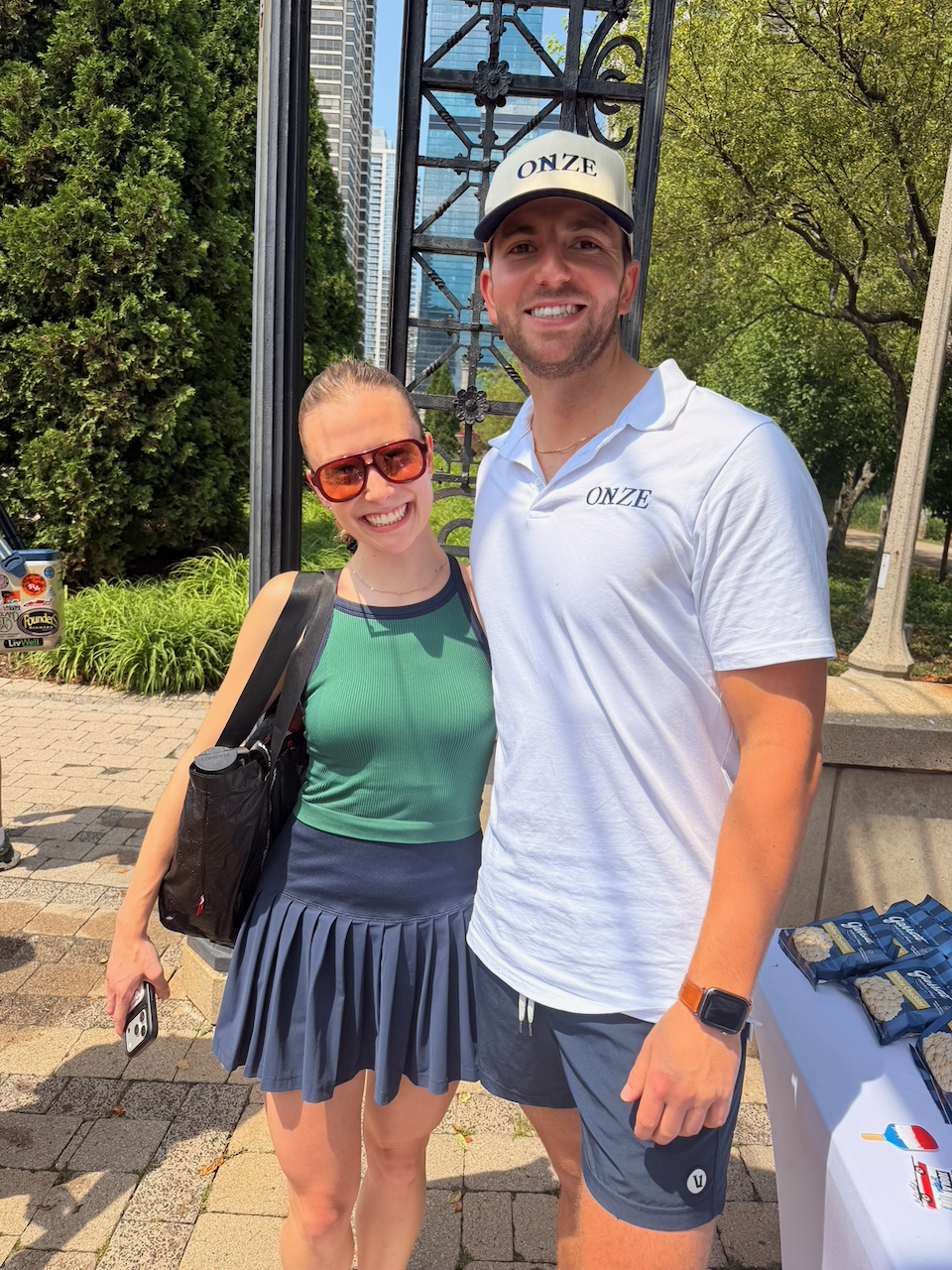
Josh Shikoff working the room at Onze Chicago
The most documented Onze partnership. TK and Josh partnered with Zappos to curate a selection of the best pickleball clothing, sneakers, and accessories they actually train in — featured on WhoWhatWear in May 2026. The integration: not a product placement. A co-created edit. Zappos let TK and Josh be the curators, not the billboards. That's brand co-authorship.
The official footwear of serious pickleball. Asics' presence at Onze events puts product on court in front of exactly the style-conscious, performance-oriented player their 2026 marketing is targeting. On-court product trial without the CPM. The brand association forms through use, not impression.
The protein bar that tastes like a candy bar — and whose entire brand positioning is built around people who want to perform and enjoy life at the same time. Onze is exactly that room. Post-match, style-forward, health-conscious young adults who make brand decisions based on what their people are using.
The functional beverage brand activating at events where the crowd skews exactly their target: 20s and 30s, active, social. Hero's event presence gets product in-hand at the exact moment a buyer is forming brand associations — mid-game, post-point, surrounded by people they want to impress.
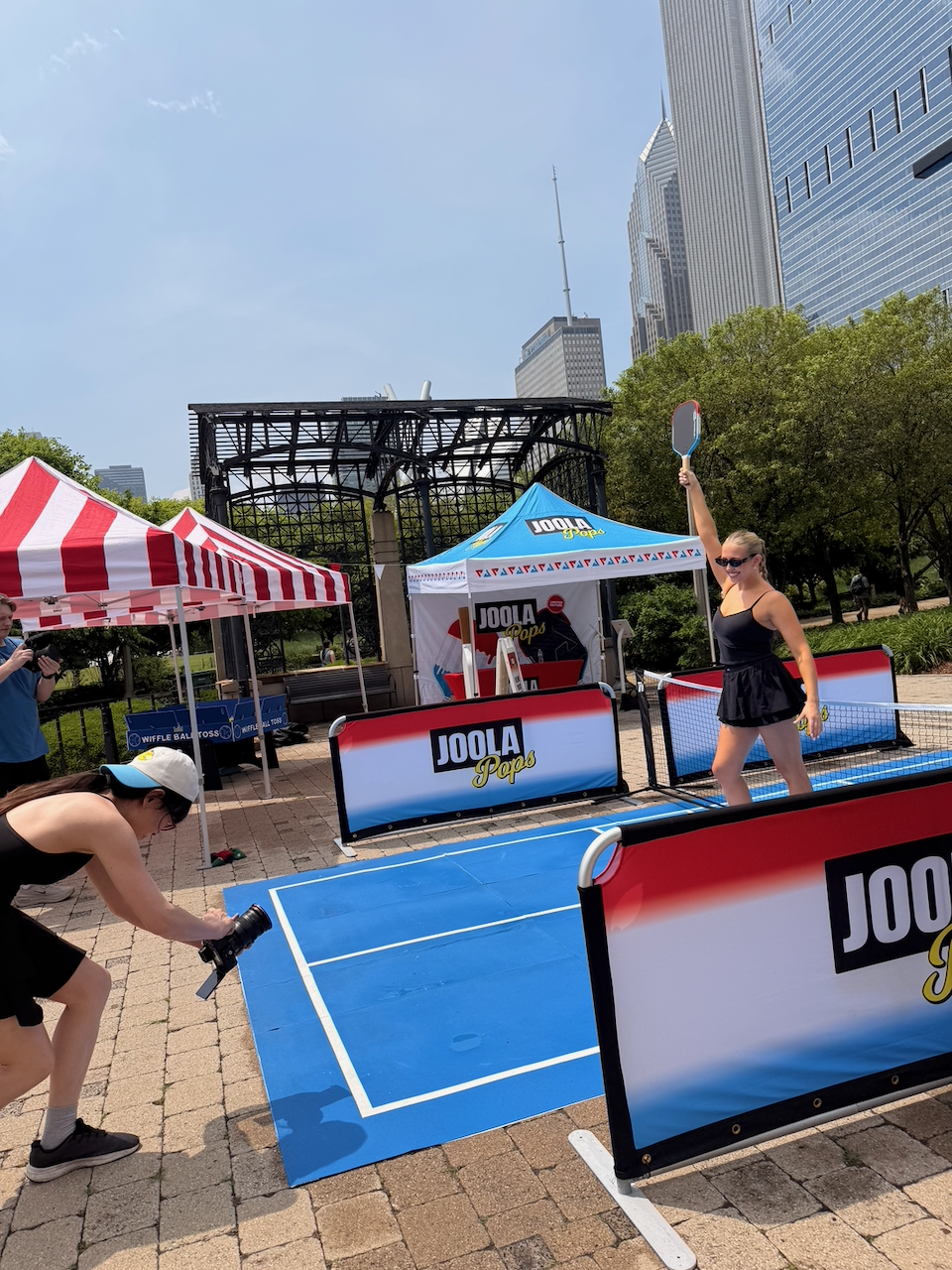
JOOLA — the paddle sport brand behind "Dink First. Decide Later." — built a full branded court and tent activation for the Chicago expansion event, with the Chicago skyline as a backdrop. This wasn't a banner. It was the literal court the games were played on. The most physically embedded brand integration in Onze's history so far, and the clearest evidence that the model scales: a national paddle sports brand showed up to a club's second-ever city.
Saint James brought a fully wrapped Jeep Gladiator sampling truck to Chicago, pouring its organic "Half & Half" iced tea and lemonade for the crowd. A mobile, photogenic activation that did double duty as content and refreshment — exactly the kind of low-friction, high-visibility brand presence that fits a community event rather than interrupting it.
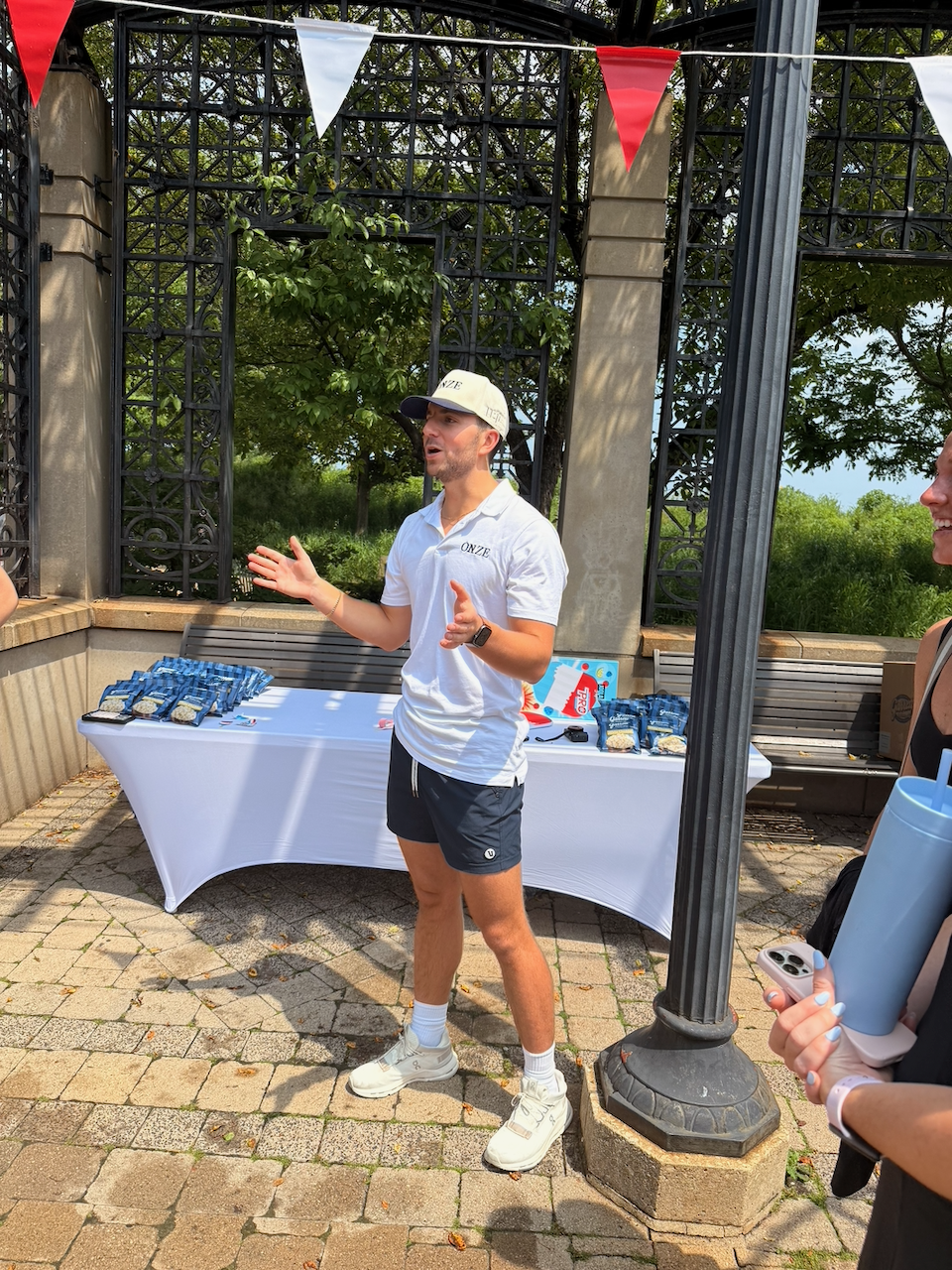
Josh addressing the Chicago crowd at the sponsor table — Garrett's Popcorn samples in view
A Chicago institution sampling its signature popcorn at the sponsor table during Josh's welcome remarks. This is the local-brand-meets-national-club move worth noting: as Onze expands city to city, pairing one or two iconic local names alongside its national partners (Zappos, Asics, Barebells, Hero) gives each new market a flavor of its own rather than a copy-pasted activation. That's a smart, low-cost way to make "expansion" feel like "homecoming" instead of "franchise."
"None of these brands showed up with a media kit. They showed up because TK and Josh built something worth showing up for."
— 80/20 Agency read on Onze brand strategyThe Zappos partnership is the one to study. They didn't pay TK to post a product. They asked her and Josh to be the curators — to pick the shoes and clothes they actually wear, and let WhoWhatWear tell that story. That's not influencer marketing. That's brand co-authorship. The shift from "creator as megaphone" to "creator as co-author" is the most important structural change in this industry right now — and Onze is the proof of concept.
The traditional influencer career arc has a ceiling. Follower growth slows. Algorithm changes reduce reach. Brand deals commoditize. The creator who is only a creator — who makes content and gets paid per post — faces an expiration date.
The creator who builds something real — a club, a brand, a community, a product — has compounding value that no algorithm update can erase.
As AI tools generate infinite content volume, the creator who builds something physically real becomes exponentially more valuable. You cannot prompt-engineer a community. You cannot automate the trust that makes someone buy something because a person they genuinely like said so. TK and Josh built a room. That room compounds every time someone walks in.
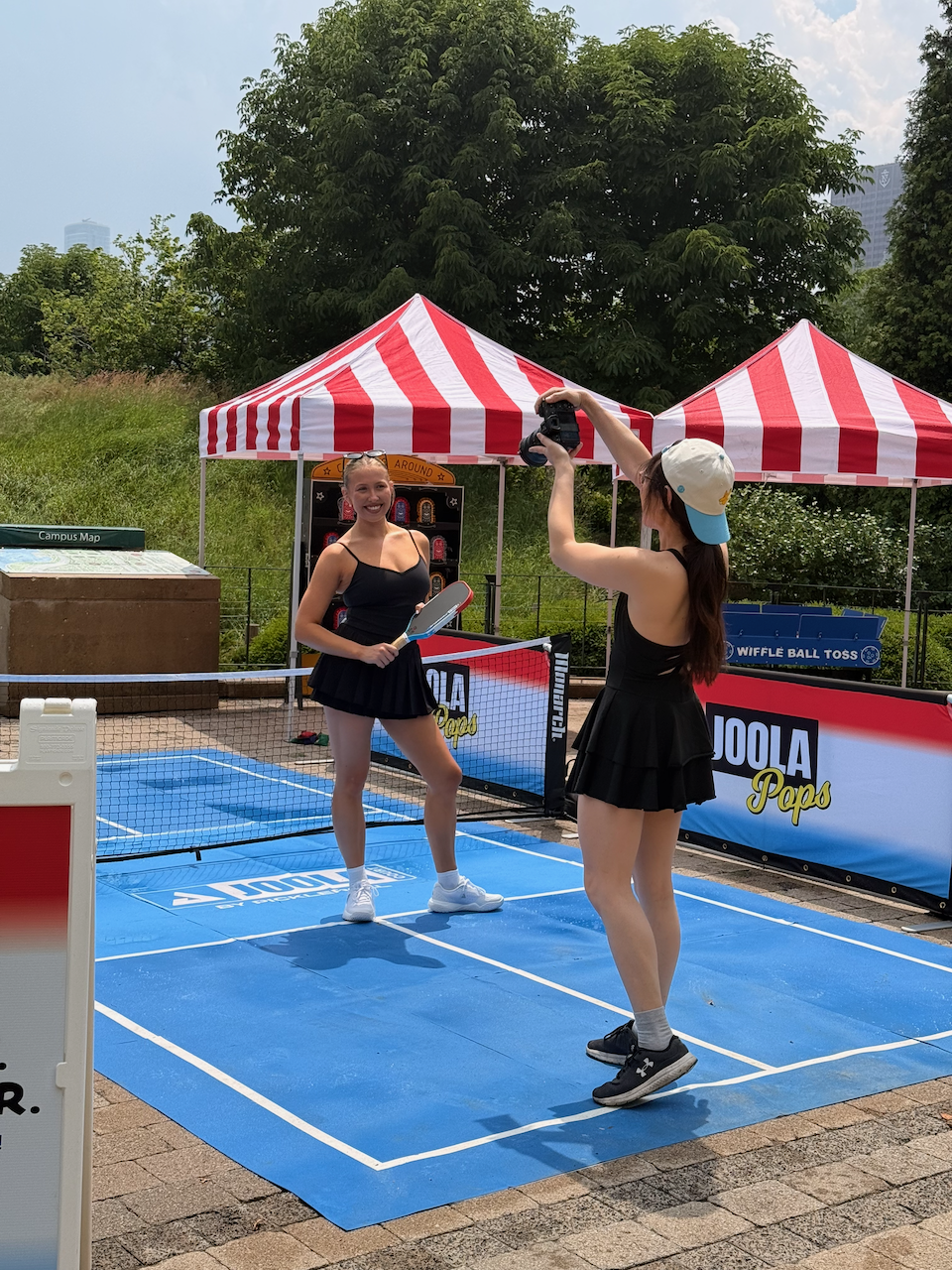
Behind the scenes: TK creating content on the JOOLA court in Chicago
That photo is the whole thesis in one frame. The club is the product. The content is the byproduct. Most creators have that order reversed.
The Onze model validates a core principle of brand equity theory: brands built on community trust have higher equity per dollar of investment than brands built on reach-based advertising. This is the case study I've been waiting to teach. The lesson isn't "do pickleball events." The lesson is: find the intersection of what your creator genuinely cares about, what their community actually needs, and what your brand can authentically add — then build something there together. That intersection is where durable brand value lives.