The NBA Finals moving to Madison Square Garden tonight is the single biggest brand moment of the summer. The Knicks haven't been to a Finals in 27 years. Game 2 at the Garden — on ABC — is primetime New York. Every brand with any cultural presence in New York needs to be paying attention.
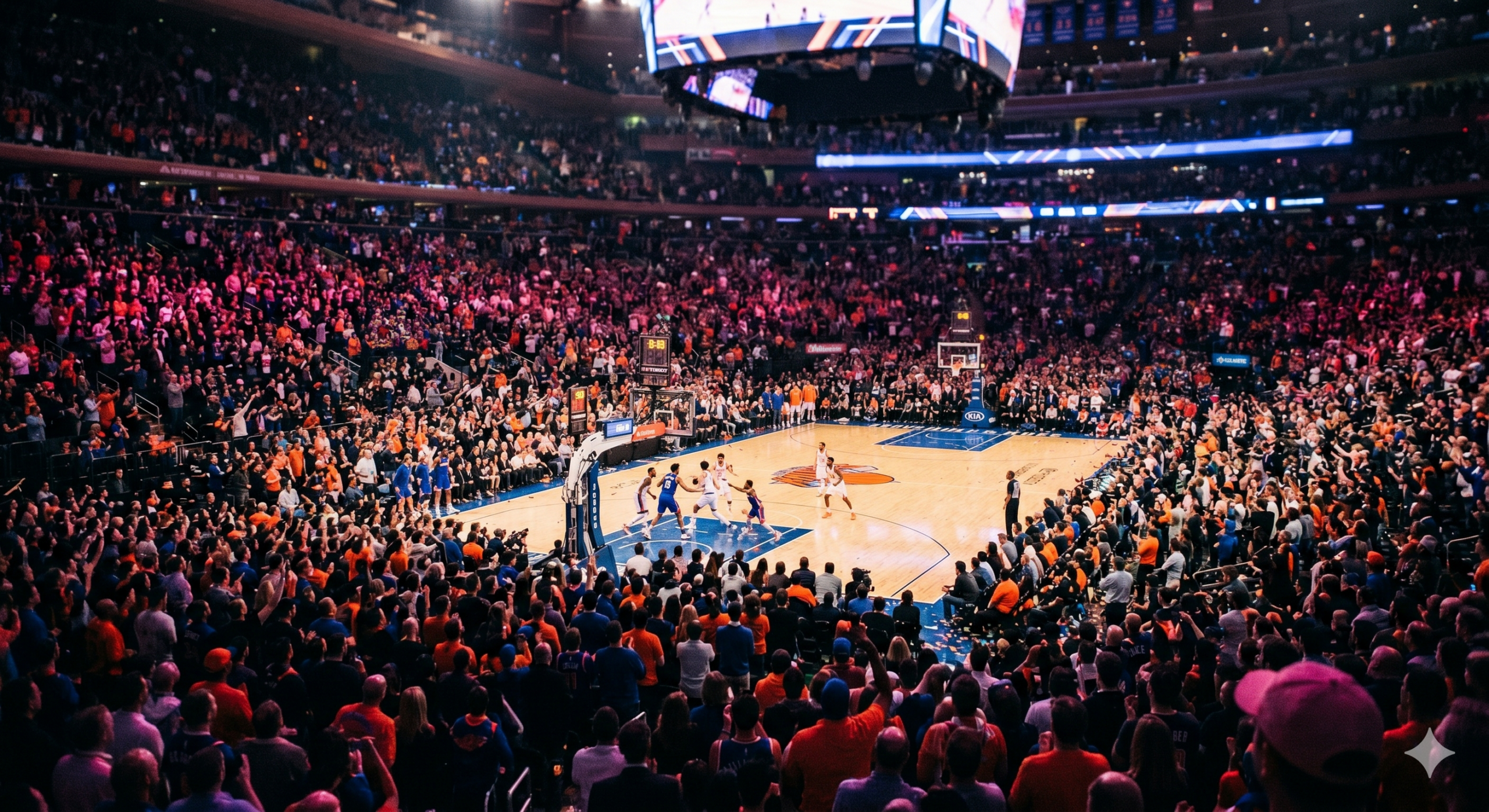
Knicks Win Game 1 on the Road. Game 2 Is Tonight at Madison Square Garden. The Brand Moment Is Now.
The New York Knicks stunned the Spurs 105-95 in San Antonio on Wednesday night — rallying from 14 points down with an 11-0 run in the final two minutes — extending their postseason winning streak to 12 games, tied for the second-longest in NBA history. Jalen Brunson finished with 30 points (13 in the fourth quarter). Victor Wembanyama had 26 points and 12 rebounds but shot just 6-of-21. The Spurs led 67-54 with under six minutes in the third quarter and still lost. Tonight, Game 2 moves to Madison Square Garden for the first time since 1999.
For brands, the Madison Square Garden storyline is the activation anchor of the summer. The Knicks haven't played a Finals game at the Garden in 27 years. New York is the #1 Nielsen DMA — 7.5M TV households, $3.3B+ in local annual ad spend. The earned media opportunity around tonight's game is enormous for any brand with New York positioning. And the series storyline is perfect for marketing: the underdog Knicks (53-29 in the regular season) against the 62-win Spurs and Wembanyama — the basketball equivalent of a classic David vs. Goliath brand narrative.
Tonight at MSG is a brand activation gift. The cultural energy around the Knicks' first Finals home game in 27 years is generational. If your brand has any New York connection, any sports adjacency, any summer campaign in market — this is the night to show up with something authentic. Reactive creative that meets the moment tonight will earn more brand equity than a planned campaign that takes three weeks to approve. The brands that win Finals narratives move fast and have a genuine point of view. What's yours?
The IAB just put a number on what every smart marketer already knew: influencer ads are now the #1 ad budget priority of 2026, with 57% of buyers increasing investment. The era of creator marketing as a bolt-on experiment is officially over. It's core infrastructure now.

Influencer Ads Are Now the #1 Ad Priority for 2026 — 57% of Buyers Increasing Investment
The IAB's 2026 Outlook Study confirms a seismic shift in ad budgets: 57% of buyers rank influencer ads and partnerships as their top investment priority this year, up from 48% in 2025. The IAB attributes the acceleration directly to brands pushing for more human storytelling in an AI-first era — as AI-generated content floods every feed, authentic creator voices become the scarce, premium inventory. During Cyber Week 2025, influencer-driven spend jumped 51% year-over-year while commission costs stayed flat, delivering dramatically improved return on the dollar.
The structural shift is equally significant: brands are moving from one-off campaign deals to long-term creator ecosystems. Instead of one face, marketers are building groups of trusted creators who show up consistently across the full buyer journey. Creator-led content is now contributing directly to acquisition efficiency, retention, and revenue with measurable impact on CAC and ROAS — sitting alongside paid social and search as a primary growth lever, not a discretionary experiment. Brands without structured creator pipelines are facing rising acquisition costs and slower creative testing velocity.
The IAB number is validation, not news — but it's the kind of validation that unlocks budget conversations. When the industry body says influencer ads are the #1 priority, CFOs stop asking "why are we spending on creators?" and start asking "are we spending enough?" For agencies, this is the moment to reframe every creator proposal from "experimental social content" to "primary performance channel." The infrastructure is there. The data is there. Now close the deals.
This is the channel maturation moment that marketing theory predicts for every emerging medium. When the IAB — the institutional body that governs ad standards and measurement — formally elevates influencer marketing to the #1 priority, it signals that the infrastructure for measurement, attribution, and standardized buying has reached the threshold where institutional money can flow confidently. This is the moment we'll look back on as the inflection point. M455 curriculum update incoming.
A new Digiday report cuts through the AI-in-creator-economy hype with the most honest assessment yet: 80% of creators are using AI somewhere in their workflow, but brands still aren't finding evidence that fully AI-generated influencers outperform human creators on trust and conversion. The verdict so far: AI makes creators faster. It doesn't make AI creators trustworthy.

80% of Creators Are Using AI — But Fully AI-Generated Influencers Still Can't Beat Human Trust
Digiday's new report on generative AI in the creator economy delivers a nuanced verdict: AI has deeply embedded itself in creators' workflows — 80% use it at some point in their process — but brands testing fully AI-generated influencers are not finding evidence they outperform human creators in campaign performance. The two questions that keep surfacing are brand safety and audience trust — and they are different questions. AI-generated influencers eliminate the "morality clause" risk of a human creator controversy. But they introduce a trust deficit that is proving stubborn to overcome at conversion-critical moments in the buyer journey.
Meanwhile, the Typeform 2026 State of AI in Marketing report puts the macro picture in context: 95% of marketers report using AI at work, with only 5% avoiding it. The defining tension of 2026 is not AI vs. no AI — it's AI-assisted human content vs. AI-generated content at scale. The brands winning the content game are the ones where human judgment leads and AI handles speed and volume. The brands losing are the ones that handed the brand to a machine because it could write quickly. Social media consultant Rachel Karten's 2026 "ins and outs" list explicitly calls out brand stance on generative AI as a brand equity signal. The audience notices.
The headline is: AI makes creators more productive, but it hasn't made AI creators more trustworthy. And trust is the whole game in influencer marketing. An AI-generated influencer can avoid a scandal, but it can't build the kind of parasocial relationship that makes a follower actually buy something because the creator said so. Human trust compounds. AI efficiency doesn't. This is the Human Leader in the Loop argument applied directly to creator marketing — and the data is backing it up.
This is the empirical test of a theoretical prediction: that trust, as a form of social capital built through authentic repeated interaction, cannot be replicated by artificial agents because audiences have social cognition systems specifically tuned to detect inauthenticity. The early results are consistent with the theory. AI-generated influencers are efficient but not trusted. Human creators using AI are both. The implication for brand strategy is clear: invest in human-AI collaboration, not AI substitution.
Broadcom reported the most interesting "beat" in recent memory: AI revenue hit $10.8B — above the $10.7B guide, up 143% year-over-year — and the stock still dropped 13%. Here's the full story, and what Hock Tan said about Anthropic on the call.
📈 AVGO — Broadcom Inc. · Q2 FY2026 Results
Broadcom beat its own AI revenue guidance — $10.8B vs. the $10.7B guide, up 143% year-over-year — but the stock dropped 13% on June 4. Why? Software revenue of $7.18B missed the $7.32B consensus; total revenue of $22.19B narrowly missed the $22.27B estimate; and critically, Q3 AI guidance of $16B (which would represent a 200%+ run rate) landed below what aggressive buy-side models had priced in. The whisper number was $2.45 EPS — Broadcom delivered $2.44. On the earnings call, Hock Tan confirmed Anthropic as one of six core XPU customers alongside Google, Meta, and OpenAI. He also announced a strategic shift to "chips only" going forward, dropping the integrated AI systems plan. Q3 revenue guidance of $32.4B beat consensus of $29.8B — but apparently not by enough.
Broadcom beat the AI revenue guide by $100M, guided Q3 to $16B in AI revenue (vs. $10.8B this quarter), and still got punished 13%. That's the "sell the news" dynamic at peak AI hype. The actual business is extraordinary — AI revenue tripling quarter-over-quarter is not something most companies do at this scale. The drop is a market expectation story, not a business fundamentals story. And the Anthropic XPU confirmation on the call? That's a detail that matters for anyone following the AI infrastructure supply chain. Anthropic is now publicly named as a Broadcom custom chip customer alongside Google and Meta.
⚠️ Not investment advice. Verify independently before any decision.
Friday. Game 2 night. Big week closing. Here's what's worth your attention this weekend.
🏀 NBA Finals Game 2 — ABC · 8:30PM ET TONIGHT · Madison Square Garden
First Finals game at MSG in 27 years. The Garden is the most electric arena in basketball when the stakes are this high. Watch the brand activations around tonight's game — the Knicks' New York homecoming is the cultural story of the week, and every smart brand with any NY connection should be showing up in the conversation right now.
🎙 Silicon Valley Girl — Marina Mogilko · Spotify + Apple Podcasts
If you haven't started yet — this weekend is the time. The Howie Liu episode on HyperAgent and the Tinker Mindset is the one to start with. Her interview style is exactly what we talked about: she asks the question the audience is already thinking, then gets the founder to actually answer it. Rare skill.
🤖 Claude for Small Business — Anthropic
Anthropic just got named publicly as a Broadcom XPU customer on an earnings call. The IPO S-1 is in process. The product story and the business story are converging in real time. Worth a deeper look this weekend if you haven't explored the HubSpot and QuickBooks integrations yet.
🚀 Anthropic S-1 — Watch Weekend Analyst Notes
The Broadcom earnings call naming Anthropic as a chip customer adds a new dimension to the IPO story. Weekend analyst notes will be working through what that means for the cost structure and infrastructure dependencies of a $47B revenue run rate business. The story is getting richer by the day.