Fifteen years of brand equity is a real thing to walk away from, and HubSpot just bet that "UNBOUND" says more about where go-to-market work is headed than "INBOUND" ever could.

HubSpot Just Retired a 15-Year-Old Name
HubSpot's flagship conference opens today in Boston under a new name: UNBOUND, replacing INBOUND after fifteen years. The sold-out, three-day event runs through Friday at the Thomas E. Menino Convention and Exhibition Center, with more than 200 sessions built around AI adoption, go-to-market strategy, and connected revenue operations rather than the inbound-marketing methodology that defined the brand's first decade and a half.
HubSpot frames the rebrand as reflecting a broader remit: the company's tools now span marketing, sales, service, and operations, not just the content-and-SEO playbook that made INBOUND famous. Thursday night's headliner is comedian Aziz Ansari, alongside a lineup of go-to-market and AI-focused main stage speakers.
Retiring a name with fifteen years of brand equity is a real risk, and HubSpot is betting the new name signals growth rather than confusing loyal attendees. Worth watching whether the rebrand actually changes what people say about the event, or whether everyone just keeps calling it INBOUND out of habit for another year or two.
Meta just closed the gap between finding a creator and running their content as an ad, folding two separate tools into one workflow.
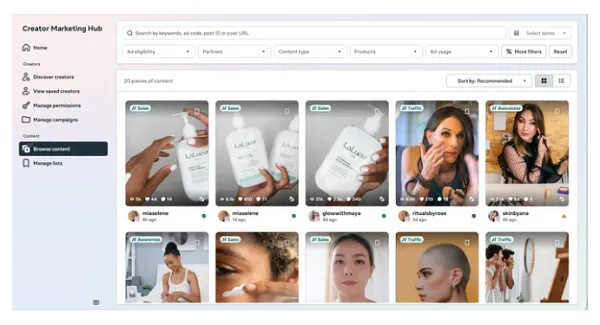
Meta Just Merged Two Creator Tools Into One Hub
Meta officially launched its new Creator Marketing Hub this week, consolidating the Creator Marketplace and Partnership Ads Hub into a single interface. The hub adds new discovery filters including a predicted affiliate content search tool, one-click ad creation directly from creator listings, content-level permissions with expiration dates, and ad editing tools that can strip copyrighted music or stickers before a post runs as an ad.
Meta is also expanding API access so third-party tools can match Meta's own discovery and evaluation capabilities, adding its Meta AI business assistant to support creator discovery inside the hub, and rolling out Instagram live video ads starting September 29, letting brands sponsor a creator's livestream directly.
The one-click path from organic creator content to a running ad is the real story here, not the rebrand. Every extra step between finding a creator and activating their content is a place a campaign stalls, and Meta just removed several of them at once.
Twenty-plus vendors sell tools claiming to measure your brand's AI visibility, and until now none of them agreed on what they were actually measuring.

The IAB Just Wrote Down What "AI Visibility" Actually Means
The IAB released "Measuring Visibility in the AI Era," the industry's first standardized framework for tracking how brands and publishers show up inside AI-generated answers. It organizes metrics into a hierarchy called the four Ps: Presence (does the brand appear at all), Prominence (how and where it appears), Portrayal (in what context and with what accuracy, including hallucination rate), and Persuasion (whether that visibility actually drives action).
The framework also splits AI visibility data into two quality tiers, directional versus decision-grade, since more than 20 vendors currently sell measurement tools using different query sets and scoring methods that can produce contradictory results for the same brand. Only 16% of brands currently track AI visibility in any systematic way, according to the research behind the framework.
Before this framework, asking "how visible are we in ChatGPT" got you a different number from every vendor you asked, with no way to know which one was real. The directional-versus-decision-grade distinction is the part worth memorizing: don't let anyone make a budget call off a directional number.
The company hosting today's biggest marketing conference is also having its most volatile trading week of the month.
HubSpot (HUBS): Up 11%, Then Down 3.5%, Right Into Its Own Event Week
HubSpot shares jumped 11.2% on Monday to close at $250.61, then gave back 3.45% on Tuesday to close at $241.96, a whipsaw week as UNBOUND kicks off. The stock is set to join the S&P MidCap 400 index on September 21, replacing Boston Beer, a move that typically draws incremental demand from index-tracking funds. Stifel raised its price target to $225 on September 11 while keeping a Hold rating; the broader analyst consensus sits at Hold with an average target of $271.90.
The volatility comes on the heels of strong Q2 2026 results, with revenue of $911.7 million up nearly 20% year over year, though the stock remains well off its 52-week high near $525.
A stock swinging double digits in back-to-back sessions right before its own flagship event is a reminder that Wall Street trades on catalysts, not vibes. The index inclusion on September 21 is the more durable story here than either day's swing, since it brings structural buying that doesn't care what happens on the UNBOUND main stage.
⚠️ Not investment advice. Verify independently before any decision.
Refreshed weekly, out with the stale, in with what's actually on Kelly's radar right now.
Ted Lasso, Season 4
Weekly episodes on Apple TV, running through October 7. Still earning the return.
Apple TV"The Art of the Brand" Podcast
Camille Moore and Phillip Millar's brand-strategy conversations remain a standing listen.
PodcastBrands & AI on CNBC
Standing watch item for how Wall Street covers the intersection of brand marketing and AI platforms.
CNBCCoach Cignetti & the Hoosiers
No. 5 IU is 2-0 after a 55-0 rout of Howard. Josh Hoover is the national leader in passing efficiency.
Multiple Outlets