Peyton Manning and Shane Gillis are back fighting over a beer, and Bud Light is betting the bit still works two decades into its NFL sponsorship.

Bud Light Kicks Off NFL Season With Manning and Gillis Fighting Over Who Gets Served First
Bud Light brought back comedian Shane Gillis and Hall of Fame quarterback Peyton Manning for a new NFL campaign built around its "Official Beer Sponsor of the NFL" status, a partnership now in its third decade. Two spots anchor the push: one has the pair escalating a fight over bar service from leaning over the counter to literally being hoisted above it, the other puts Manning at home deciding whether to give up his chair or go without a beer, and he picks a destructive third option.
Alongside the ads, Bud Light is bringing back its team-branded can designs across 27 NFL teams, full team colors, retro jersey stripes, bold logos, plus a QR code on cans and point-of-sale displays that lets fans 21-and-over enter to win NFL+ Premium, tailgating gear, and game tickets. SVP of Marketing Todd Allen framed it plainly: "The NFL season is Bud Light season," leaning on two decades of sponsorship equity rather than reinventing the pitch.
The bet here is continuity, not novelty. Gillis and Manning are returning talent, the team cans are a returning mechanic, and the QR-code prize layer adds a modern participation hook on top of an otherwise familiar seasonal playbook.
This is a brand leaning entirely on chemistry and timing rather than a big creative swing, and that's the right call for a sponsor this deep into a category-defining partnership. Gillis brings the exact younger, chronically-online audience Bud Light needs after its 2023 stumble, paired with Manning's built-in credibility with the traditional NFL viewer. The real mechanic to watch is the QR code layer: it turns a can into an entry point instead of just a vessel, which is a much more measurable participation loop than past team-can pushes ever had.
Good example for the Brand Management Practicum of sponsorship-equity brands choosing continuity over disruption. Ask students why a 20-plus-year sponsor would run the safer play here instead of a bigger creative swing, and what that says about risk tolerance once a brand owns a cultural moment as clearly as Bud Light owns NFL gameday.
New holiday research puts a number on something worth repeating to any client treating AI visibility and creator budgets as competing line items.
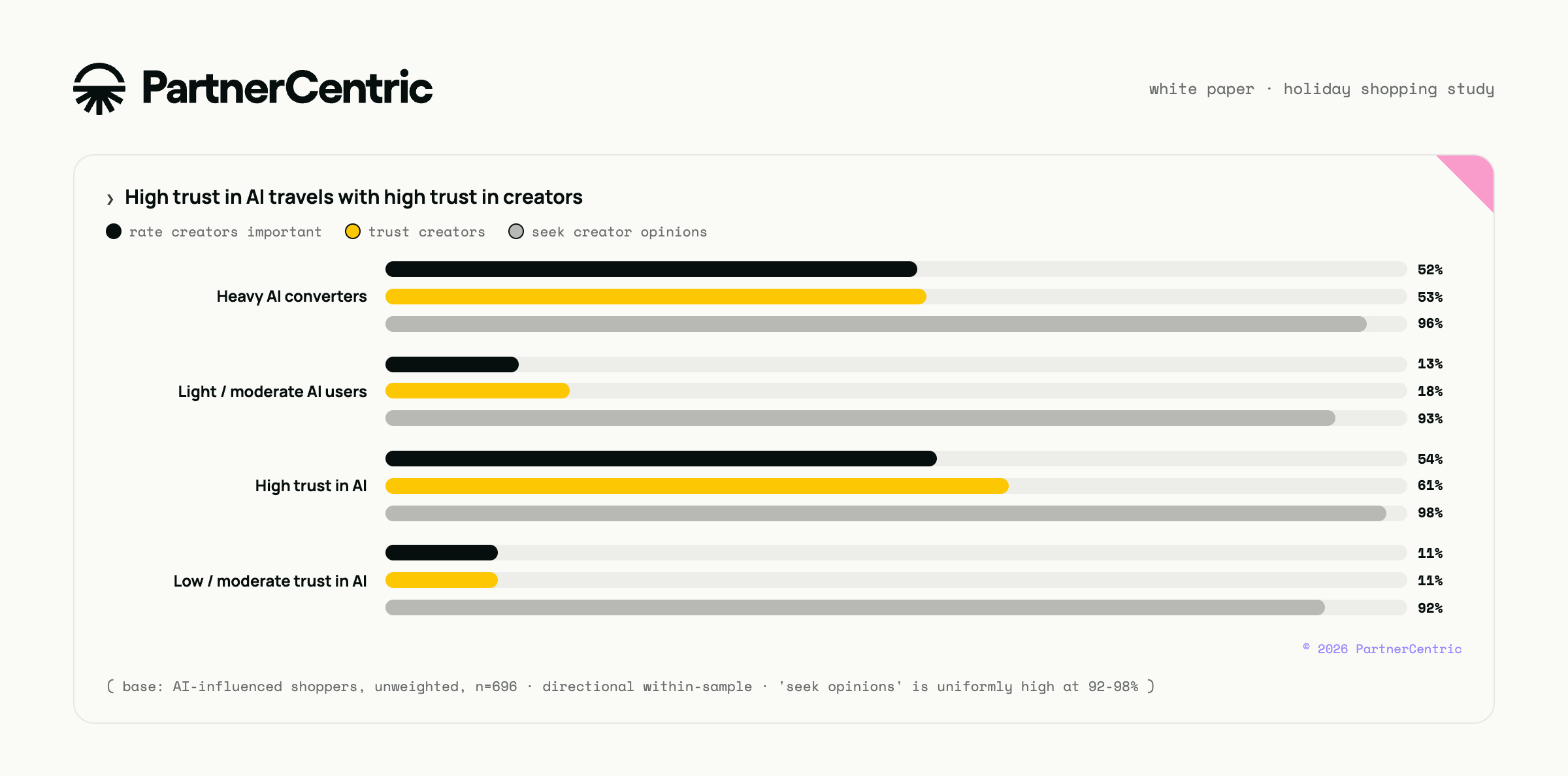
Shoppers Who Trust AI Are Six Times More Likely to Trust Creators. The Two Aren't Competing for the Same Budget.
PartnerCentric's new holiday playbook, based on a dual-panel survey of 696 AI-influenced shoppers and 319 paid or affiliate creators, found that 43% of surveyed shoppers bought a product recommended by an AI chatbot in the past three months. The more useful finding sits underneath that headline: among shoppers who trust AI, 54% also rated creators as important and 61% said they trust creators, compared with just 11% on both measures among shoppers with low AI trust.
AI trust and creator trust rise together rather than trading off. The study frames AI as a discovery layer and creators as the proof layer: 44% of shoppers want reviews before acting on an AI recommendation, and 31% ignore AI recommendations that feel generic. Adoption skews young, shoppers 18 to 34 are AI-native, with 32% starting product research on AI and 42% using it daily, while shoppers 55-plus are the mirror image.
Disclosure cuts the opposite direction from what many brands assume. Among heavy AI converters, 62% say sponsored or paid labeling actually increases their trust in a recommendation, versus only 12% who say it decreases it. Fulfillment terms matter too: half of heavy AI converters say shipping timelines and return policies change what they buy, compared with 22% of lighter AI users.
This is the study to hand any client who's been quietly shifting creator budget into an AI visibility line item as if the two compete. They don't, they're the same trust system with two different jobs: AI gets a product in front of someone, creators and reviews make the recommendation believable enough to act on. The disclosure finding is the one I'd lead with in a client meeting, because it runs against instinct: heavy AI shoppers reward transparency about sponsorship rather than punishing it. Hiding the paid relationship is the actual risk, not disclosing it.
Standing monitor: the black box around AI advertising just got its first real crack, and the number inside it is bigger than most marketers assumed.
26% of ChatGPT Responses Now Carry a Sponsored Ad. Nobody Could See That Until Today.
Similarweb launched AI Ads on August 17, a new Ad Intelligence dataset giving advertisers a competitive read on paid placements across ChatGPT, Google AI Mode, and Google AI Overviews, three surfaces that carry advertising with no public transparency layer behind them. The company reports that 26% of ChatGPT responses shown to Free and Go tier users already carry a sponsored ad, nearly 30% of ad-eligible Google AI Mode queries show ads, and more than 40% of Google searches now trigger an AI Overview that often includes ads.
The gap Similarweb is filling is structural. Meta has the Ad Library, Google has its Ads Transparency Center, TikTok has the Creative Center, ChatGPT, AI Mode, and AI Overview have none of that, not even for an advertiser's own placements. Google Ads reporting doesn't segment AI Overview performance from other premium placements, so a brand can be running inside an AI answer with no line in any report telling them so.
The release lands the same week Synchrony announced a ChatGPT plugin for its financing offers, Omneky added self-serve ChatGPT campaign buying, and Uniphore and Acoustic both launched individual-level predictive marketing tools, six separate announcements in two days that each attach a commercial mechanism, measurement, buying, financing, or creative, to the same conversational AI surface, with no independent standard yet to reconcile any of their competing numbers.
File this straight into the ChatGPT Ads Manager watch list, this is the update that actually changes the calculus. A quarter of ChatGPT responses already carrying ads means the channel has real inventory behind it, not just a pilot program, but the complete absence of a public transparency layer means we'd be buying blind and measuring with a vendor's own panel. Before committing real budget here, I want at least one independent read on delivery, not just Similarweb's numbers and Similarweb's dataset checking each other's homework.
Useful for the Exec Ed AI Applications seminar on measurement asymmetry in new ad channels. Ask the room what it means that the same company selling access to a market opportunity is also selling the instrument used to verify it worked, and whether that's meaningfully different from Nielsen rating the networks that pay for Nielsen ratings.
Super Micro missed its own revenue guide and the stock ripped higher anyway, because the margin story underneath was the one Wall Street actually wanted.
Super Micro Computer (SMCI): Record Backlog and a Margin Surprise Send the Stock Soaring
Supermicro's fiscal Q4 2026 revenue landed at the low end of its $11 billion to $12.5 billion guidance range, but the number nobody expected was margin: gross margin came in at 15% to 17%, more than double the 8.2% to 8.4% the company had guided in May, on a more favorable customer and product mix. Shares popped more than 10% on the print and kept climbing through the following days.
The backlog is the bigger story for anyone modeling this out further than one quarter. Supermicro closed fiscal 2026 with more than $60 billion in new orders received in Q4 alone, all still to be delivered in future quarters, and full fiscal-year 2026 revenue reached $39.1 billion, up 78% year over year. Management guided fiscal 2027 revenue to $16 billion, above what Wall Street had modeled, betting the order book converts on schedule.
Analysts responded with a wave of price target increases across the board: Barclays and Citi both to $39, Wedbush to $40, Rosenblatt to $51, and Bernstein most recently to $42. A separate fair-value model from Simply Wall St lifted its own estimate to $41.75 from $37.25 following the print and subsequent order-book disclosures. Not every signal was clean, the company also disclosed a $188.1 million inventory write-down and continues facing an ITC patent complaint.
This is a useful counterpoint to the Pinterest story from yesterday: SMCI actually missed its own revenue guidance and the stock ripped higher anyway, because margin and backlog told a better forward story than the top-line number did. Worth remembering for any client fixated on hitting a single headline number in a forecast, the market is increasingly reading the components underneath a beat or miss, not just whether the miss happened. The $60 billion order book is the number to watch next quarter, since that's the promise the current price target increases are actually betting on.
⚠️ Not investment advice. Verify independently before any decision.
The standing lineup, no changes today.
NBA Finals Recap
The Knicks won the championship. Still the standing sports pick until something replaces it.
ABC/ESPNClaude for Small Business
Anthropic's push into small business tooling. Worth tracking as a comp for our own AI-in-the-loop positioning.
AnthropicAnthropic IPO S-1
$965B valuation, $47B run rate. Watching how the media frames the filing as it moves through the process.
S-1 FilingSilicon Valley Girl
Still the sharpest lens on tech culture from the inside. Recommended for anyone building a personal brand in AI.
YouTube"The Art of the Brand" Podcast
Camille Moore and Phillip Millar keep delivering the best brand-strategy conversations in podcast form right now.
PodcastTed Lasso, Season 4
Premiered August 5. Ten episodes, weekly, through October 7. Early word is it earns the return.
Apple TV