Gap didn't ask a musician to cover a song. It asked him to make it his own, and built an entire denim platform around that same idea.

Gap Didn't Ask Malcolm Todd to Cover "Dancing on My Own." It Asked Him to Reinterpret It.
Gap unveiled "Denim on Your Own," its Fall 2026 campaign starring musician Malcolm Todd and actress Inde Navarrette, built around Todd's original rendition of Robyn's "Dancing on My Own," created specifically for the campaign. Directed by Tanu Muiño with creative direction from Calvin Leung, the film follows both talents bringing their own rhythm and style to GapDenim, framing personal style as a form of self-expression rather than a product pitch.
Gap brand CMO Fabiola Torres was explicit about the brief: "For this campaign, we didn't simply ask Malcolm to cover 'Dancing On My Own,' we asked him to reinterpret the song through his own perspective. That same spirit of making something your own defines GapDenim." The Fall 2026 collection builds on denim heritage dating to 1969, with refreshed washes and new silhouettes including a Mid-Rise Straight Taper Jean and a returning '90s Loose Jean.
The pairing itself is the strategy. Todd brings multiple platinum-certified songs and a 38-date North American tour; Navarrette brings the audience from OBSESSION. Neither is primarily known for fashion, which is exactly the point: Gap is borrowing cultural credibility from music and film rather than leaning on a traditional model-led denim campaign.
The brief is the whole lesson here. "Reinterpret it, don't cover it" is a completely different creative instruction than "perform this song for our ad," and you can feel the difference in the result. Gap is buying originality, not familiarity, and that's a harder, more expensive thing to commission, which is exactly why it reads as premium instead of generic. If a client ever asks you to license a cover song for a campaign, this is the version to point to: commission something new that only exists because of the partnership.
TikTok Shop is closing in on $100 billion in GMV, and the shift underneath the number matters more than the number itself.
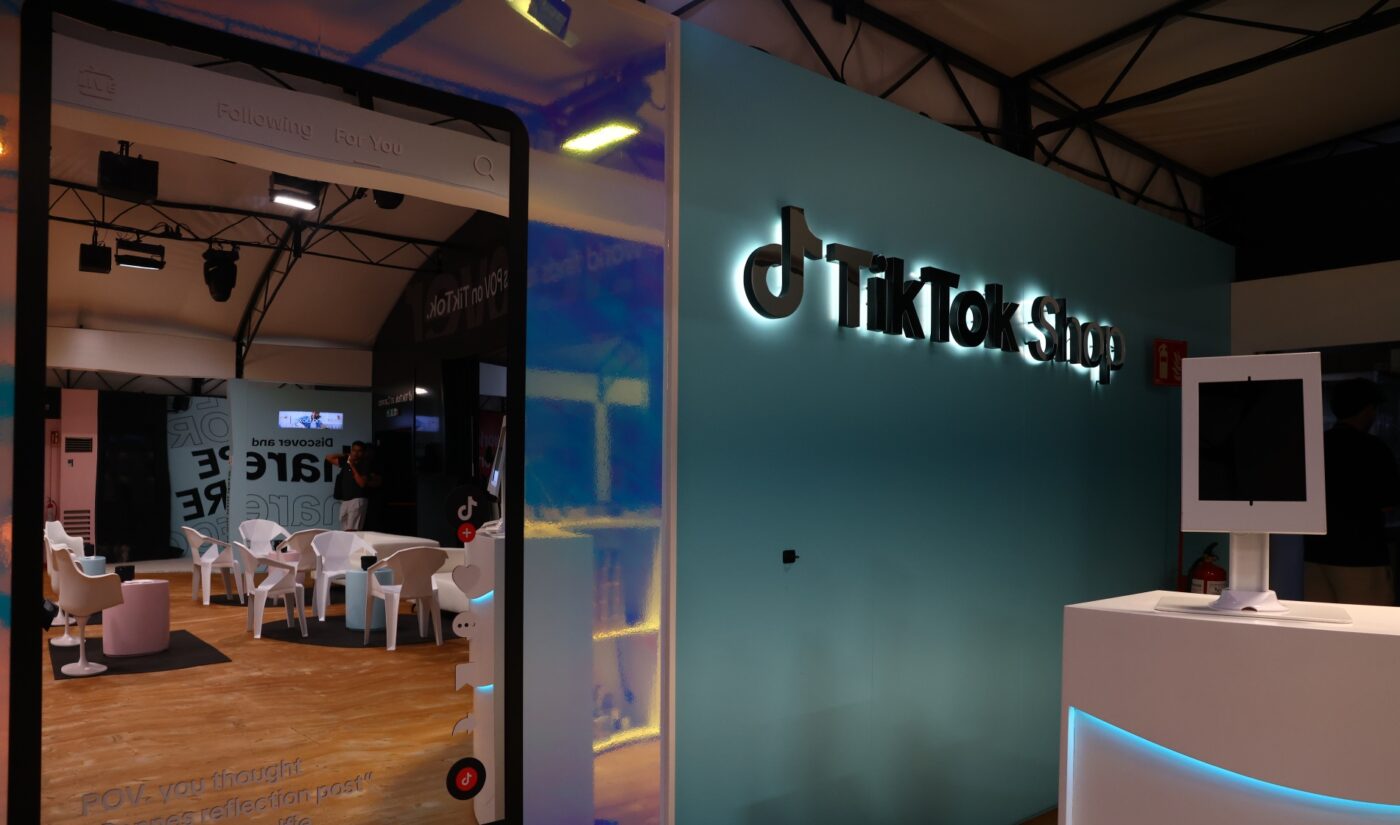
TikTok Shop Is on Track to Clear $100 Billion in GMV This Year. The US Is Now Its Biggest Market.
TikTok Shop's global GMV reached $50.3 billion in the first half of 2026, up 92% year over year, according to a report from Momentum Works and Tabcut. That pace puts the platform on track to comfortably clear $100 billion for the year, with Momentum Works projecting a final 2026 total of $123.5 billion. Five years ago, TikTok Shop's annual GMV totaled less than $1 billion.
The US is doing the heavy lifting. US GMV reached $11.8 billion in H1 2026, up 103% year over year, reclaiming the top spot from Indonesia and the rest of TikTok's Southeast Asia base. That's a meaningful shift: East Asia and Southeast Asia used to be ByteDance's most lucrative ecommerce markets, and the US only overtook them in 2024.
The mix inside the US is shifting too. The Shop tab now accounts for slightly more than half of attributed GMV, with video driving roughly 40% and livestream making up the remaining 8%, a departure from the livestream-led model that still dominates TikTok Shop in China and Southeast Asia. For context, TikTok Shop still trails Amazon's roughly $200 billion in quarterly global GMV, but the growth curve is the story, not the absolute scale yet.
The US reclaiming the top market spot from Southeast Asia is the detail worth repeating to any client still treating TikTok Shop as a side experiment. This isn't a livestream-driven impulse-buy platform anymore in the US, the Shop tab closing the majority of sales means it's starting to behave like a real commerce channel with discovery and conversion happening on the same platform. If you're still running TikTok purely as an awareness play without a shoppable storefront behind it, you're leaving the fastest-growing half of the platform's value on the table.
Gemini just pulled even with ChatGPT on raw scale. The AI assistant race just became a genuine two-horse race for consumer attention.

Google's Gemini App Crosses 1 Billion Monthly Users, Now Level With ChatGPT
Google CEO Sundar Pichai announced the Gemini app has surpassed 1 billion monthly active users, calling it the company's fastest-growing product ever and its 14th to hit the billion-user mark. The milestone puts Gemini in close range of OpenAI's ChatGPT, which crossed 1 billion monthly active users back in June, effectively turning the consumer AI assistant race into a genuine two-horse contest at the top of the market.
The usage detail worth noting: 63% of Gemini users interact with the assistant through voice, and the app generates more than 150 million images every day. The figure specifically covers the standalone Gemini app and excludes Google's AI Mode in Search, which has separately crossed 1 billion monthly users of its own, meaning Google's total AI-touched audience is considerably larger than the headline number suggests.
Gemini's growth isn't confined to Google's own ecosystem either. The app now has more than 100 million active users on iOS, arriving right after Google's Q2 2026 earnings call reported daily active users had tripled over the past year. That cross-platform reach matters for anyone tracking where AI-assisted search and content discovery are headed next.
ChatGPT and Gemini sitting at the same billion-user line changes how I'd advise a client thinking about AI visibility strategy. This isn't "optimize for ChatGPT and hope the rest follows" anymore, it's two comparable audiences at real scale, each with different usage patterns, voice-heavy for Gemini, and different discovery mechanics. If your AI-visibility work only accounts for one platform, you're now missing half the field, not a rounding error.
Good example for Exec Ed on distribution advantage in platform competition. Gemini didn't win by being a better standalone product first, it won partly by being embedded everywhere Google already had reach: Search, Workspace, Android, and now a strong iOS foothold despite not owning that operating system. Contrast that with ChatGPT's single-app-first growth path and you get two different playbooks for reaching a billion users.
Reddit just made the S&P 500. The market reaction was immediate, even if index inclusion alone doesn't always hold.
Reddit (RDDT): S&P 500 Inclusion Sends Shares Up 15% in a Single Session
S&P Dow Jones Indices announced Reddit will join the S&P 500 before markets open on August 18, replacing AvalonBay Communities, which is being acquired by fellow index member Equity Residential. Reddit shares jumped as much as 15%, trading up to $182, making it only the second pureplay social media company in the benchmark index alongside Meta Platforms. Inclusion forces index-tracking funds managing trillions of dollars, including the Vanguard S&P 500 ETF and BlackRock's iShares Core S&P 500 ETF, to buy shares to match the rebalance.
The bounce matters because Reddit needed one. Shares had lost 22.2% over the past month and were down roughly 31.2% year to date heading into the announcement, following a volatile stretch that included a post-earnings drop of more than 22% in a single session in late July. Analysts remain broadly constructive regardless: DA Davidson kept a Buy rating with a $200 price target, and the company's Q2 print showed a rare combination for a growth-stage social platform, a profit margin north of 30% and gross margin near 96.5%.
Whether the index bump holds is an open question. Charles Schwab data shows Tesla shares kept rising 60% between its S&P 500 announcement and actual addition in 2020, one of the largest inclusion rallies on record. Workday saw the opposite: an initial 10% pop that had fully reversed, down 19% from its peak, by the time it actually joined the index in December 2024.
The Tesla-versus-Workday split is the real lesson buried in this story. An index-inclusion pop is a mechanical demand event, not a verdict on the business, and whether it sticks depends entirely on whether the fundamentals hold up once the passive-fund buying is done. Reddit's margins are unusually strong for a platform this size, which gives the bull case more to stand on than Workday had. Still, don't let a client mistake this week's 15% pop for a trend confirmed. Watch where the stock sits a month after the actual Aug 18 addition, that's the real signal.
⚠️ Not investment advice. Verify independently before any decision.
The standing lineup, no changes today.
NBA Finals Recap
The Knicks won the championship. Still the standing sports pick until something replaces it.
ABC/ESPNClaude for Small Business
Anthropic's push into small business tooling. Worth tracking as a comp for our own AI-in-the-loop positioning.
AnthropicAnthropic IPO S-1
$965B valuation, $47B run rate. Watching how the media frames the filing as it moves through the process.
S-1 FilingSilicon Valley Girl
Still the sharpest lens on tech culture from the inside. Recommended for anyone building a personal brand in AI.
YouTube"The Art of the Brand" Podcast
Camille Moore and Phillip Millar keep delivering the best brand-strategy conversations in podcast form right now.
PodcastTed Lasso, Season 4
Premiered August 5. Ten episodes, weekly, through October 7. Early word is it earns the return.
Apple TV