Snickers just turned comment-section chaos into a job listing, and it might be the cheapest engagement play of the summer.
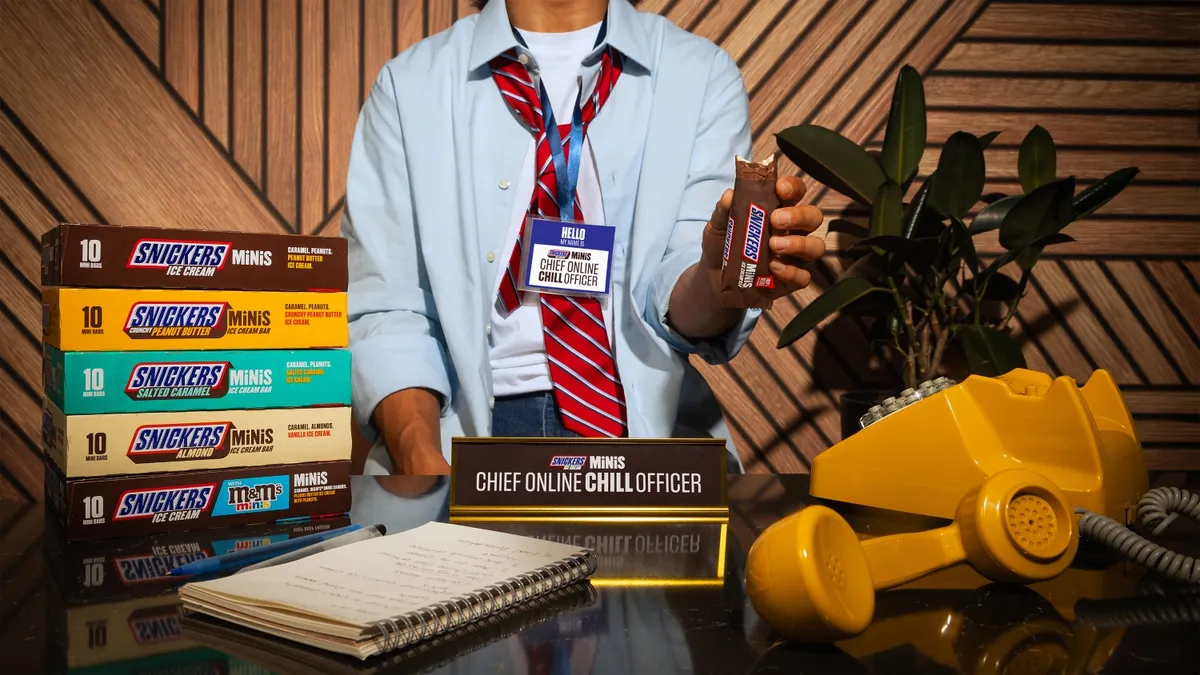
Snickers Is Hiring Someone to Fight the Internet's Bad Vibes.
Snickers Ice Cream is hiring a paid "Chief Online Chill Officer" for a two-week gig running Aug. 24 to Sept. 3, hybrid, based in Chicago. The job: find heated internet moments, sports debates and the like, and respond with witty comments plus coupons for Snickers Ice Cream. The campaign spotlights the brand's Minis line, which launched in January and comes in five flavors, including a Snickers x M&M's crossover.
The premise leans on real data. Social media use is linked to higher rates of irritability in U.S. adults, and Snickers is positioning its ice cream as the fix, the same "you're not you when you're hungry" logic extended into a comment section. It also rides the "little treat" economy, where Gen Z and millennials spend more on small, affordable indulgences as bigger purchases stay out of reach.
This is a masterclass in cheap distribution. One paid hire gets Snickers community engagement, product sampling, and a steady stream of shareable content, all from a single person instead of a media buy. Comment sections are brand surface area now, and Snickers just proved you can staff that surface area for less than a single influencer contract. Watch how many CPG brands copy this exact structure by fall.
Brands want more creator content than ever. The pool of creators willing to reliably produce it is shrinking, and new data shows exactly why.

The Creator Supply Problem Is a Bigger Story Than the Engagement Numbers.
New August creator economy data points to a supply problem disguised as an engagement problem. Incogni's 2026 digital burnout survey found 55% of Americans are posting less to social media than they did five years ago, and 51% describe maintaining a social presence as something that "feels like work." More than half of creators now earn under $15,000 a year from their content, up from 48% just two years ago.
Meanwhile, Meta's own engagement data shows time spent on Instagram and Facebook rising mostly because of algorithmic short-video insertion, not because people are posting more themselves. As casual posting drops off, content creation is consolidating into a smaller group of prolific, professionalized creators who treat it like an actual job, which is exactly the trend brands are chasing with bigger budgets and fewer available partners.
This is the tension every brief I'm writing right now runs into: everyone wants more creator content and fewer people want to be the one making it. The professionalized, prolific creator tier is where the real value is concentrating, and that tier is small and getting pickier. If your influencer strategy is still built around a large roster of casual posters, it is time to rebuild it around fewer, deeper, better-paid partnerships. The supply side is telling you where this is headed.
Adobe just made a bet that the future of creative work happens inside a chat window, not a native app.

Adobe Just Put Its Whole Creative Suite Inside ChatGPT.
Adobe launched a new ChatGPT plugin bringing tools from Photoshop, Firefly, Premiere, Acrobat, Lightroom, Illustrator and InDesign directly into OpenAI's chat interface. Instead of opening a native Adobe app, users can now prompt creative edits, generate assets, or manipulate files without leaving the conversation.
The move comes the same week Gartner projected that more than 70% of global ad spend will flow through AI-led self-serve platforms by 2028, and the same day WPP's CEO said AI is cutting agency production costs enough that clients will start demanding a share of the savings. The common thread: the tools that used to define a creative professional's workflow are becoming background infrastructure other AI products call on demand.
Adobe choosing to live inside a competitor's chat interface instead of forcing people into its own apps is the tell here. The company that used to own the creative desktop is now betting its future on being the best plugin, not the best platform. That is a hard pivot for a company built on subscription software, and it says something about where Adobe thinks creative work is actually happening in two years.
This is a clean example of the "features become infrastructure" pattern in platform economics. When a dominant tool gets embedded inside a broader interface it doesn't control, it trades direct customer relationships for distribution reach. Track whether Adobe's core subscription revenue holds steady as ChatGPT usage of these tools grows, that ratio will tell you who actually wins this arrangement.
Separate from today's lead story: DoubleVerify jumped on real M&A news worth tracking in its own right.
DoubleVerify Holdings (NYSE: DV)
DoubleVerify shares jumped roughly 13% following news of Nielsen's all-cash acquisition offer of $13.60 per share. Q2 2026 results showed modest 3% revenue growth but strong profitability, with a 34% adjusted EBITDA margin, solid free cash flow, no debt, and $210 million in cash on hand. Scotiabank cut its rating to Sector Perform and pegged its price target at the $13.60 deal price, signaling the Street sees the stock as a merger-arbitrage play now rather than a growth story.
Rotation note: today's pick moves off yesterday's AppLovin miss to a live M&A situation, a different kind of stock story worth understanding separately from a growth or earnings play.
The standing lineup, no changes today.
- 🏀NBA Finals recap, ABC/ESPNThe Knicks won the championship. Still the standing sports pick until something replaces it.
- 🏢Anthropic IPO S-1$965B valuation, $47B run rate. Still watching how the media frames it.
- 🤖Claude for Small Business, AnthropicKeeping an eye on adoption and case studies.
- 📱Silicon Valley Girl, YouTubeInterviews with AI leaders, good for pulling quick lessons.
- 🎙️"The Art of the Brand" podcast, Camille Moore and Phillip MillarAdded after Creator Economy Live East. Still recommending it.
- ⚽Ted Lasso Season 4, Apple TV10 episodes weekly through October 7.